The Corner Gas Station

AI generated image.

By M. Snarky

In 1979 I was basically a broke, skinny, long-haired, hot-headed, smart-ass 18-year-old punk between jobs. I was also earnestly looking for employment in the L.A. Times classifieds, but the economy wasn’t doing so great so there weren’t many jobs available. I eventually took a job at the Union 76 gas station at the northwest corner of Whitsett Avenue and Vanowen Street in North Hollywood, California, because, thankfully, my brother Scott was already working there as a mechanic, and he got me the job by word-of-mouth. The pay was $3.50 per hour. Don’t laugh. Granted it wasn’t much money, but at least it was above the minimum wage and enough to buy food and make rent.

I’ve managed to maintain some of that hot-headed smart-ass punk attitude, albeit nowadays is it mostly reserved for the people who deserve it; like the ones that drive like a-holes, and the ones that cut in line, and the ones that bring 20-items to the 10-item or less express checkout line at the grocery store.

I quickly found out that you meet some very interesting people at the corner gas station.

The gas station owner was a man named George Christie, a divorced, cranky, chain-smoking, coffee chugging, foul-mouthed WWII army captain who was only about 5-feet-8-inches tall. Scott was 6-2, and I was 6-feet even, and so Mr. Christie always had to look up to us when he talked to us. This seemed to perpetually piss him off and make him swear more than usual, meaning that every third word was an expletive instead of every fourth word. In one single sentence, George Christie would string together more expletives than the saltiest of Navy sailors could do in an entire year. George Christie made swearing an art form.

Mr. Christie’s primary job was a Southern Pacific Railroad (SPRR) locomotive engineer working the graveyard shift and the gas station was his little side hustle. I don’t believe the man ever slept for more than four hours at a stretch. Mr. Christie had a socially awkward teenage son (the name of whom I cannot recall), and his son had a governess with him at all times. She was a homely, chubby, middle-aged woman and it didn’t appear to us that the son had any special needs that required any, um, governing, however, Mr. Christie loved to brag about his sexual activities with the old, fat, ugly matron, which—to use the vernacular of the day—was grody to the max. I’ll spare the reader the sordid graphic details that Mr. Christie delighted in telling us.

By today’s standards that gas station was the epitome of an old school operation. Us “Gas Jockeys” wore matching navy-blue uniforms with the Union 76 logo on the right side of our chest and our name patch on the left side of our chest. No snacks or drinks or rolling hot dogs of questionable age and origin for sale; only gas, oil, a handful of basic car parts and basic car repairs and maintenance services. There was one self-service and one full-service island. Each island had two pumps with two hoses each—one pump was for regular gas and the other pump was for premium. Theoretically, we could be pumping gas for up to eight cars at once, but that never happened. There was a pneumatic black rubber tube that ran across all of the service driveways which rang a bell inside the two-car service bay when a car drove over the tube, alerting us that someone had pulled in. This is when would jump into action.

Most customers paid cash, and a small percentage of them used credit cards, including an exclusive Union 76 gas card with the distinctive orange ball logo. Generally speaking, the people with credit cards drove nice late model cars. I foolishly applied for one of these gas cards thinking I would have an advantage by being an employee of a Union 76 gas station, but it was declined due to insufficient credit history—my FICO score was stuck at 0.

We had to use these infernal manual imprint machines for the credit cards—the ones where you first insert the credit card into a slot at the top of the machine and then you place a blank, Union 76 branded pre-punched serial numbered three-layer carbon copy receipt sheet over the index pins on the left-hand side, lay the sheet over the credit card, and then slide the imprint roller over the entire assemblage from left to right, making a distinct shook-shook sound. This system did not work flawlessly. The machine would jam frequently and sometimes the imprint was off by quite a bit requiring a re-imprint. Mr. Christie was so frugal that he tracked the receipts and made us pay a dime for each one of them that were wasted. Definitely overpriced and probably illegal, but we didn’t know any better. There was no written company policy, or employee handbook, or HR department, or mid-level manager to file our grievances with: There was only Mr. Christie, and he was the self-appointed judge, jury, and executioner of his gas station fiefdom.

After imprinting, we would manually write down how many gallons were pumped, the price per gallon, and the total price that was displayed in the gas pump window onto the right-hand column of the receipt and then ask the customer to verify the total and then ask them to sign the receipt on the line, then we would tear off the top copy and hand it over to the customer. Next, we would tear off the middle carbon copy sheet and throw it away, and then ring up the total on the digital NCR cash register which would print out another receipt that we stapled to the imprint receipt, and then finally insert the bonded receipts into a slot in the front of the cash drawer. It was a spectacularly idiotic time-consuming tedious process, especially by today’s chipped credit card transaction standards, but at the time it was relatively state-of-the-art. Every now and then a nice lady would tip me a buck or two in cash before driving off which, speaking for myself here, would go unclaimed and directly into my pocket.

Cash was an entirely different animal. Mr. Christie would leave a cash drawer in the safe containing exactly $147.50 in the following denominations and quantities:
$20 x 3
$10 x 4
$5 x 4
$1 x 10
$10 – roll of quarters
$5 – roll of dimes
$2 – roll of nickels
.50¢ – roll of pennies

At the 9:00 PM closing hour, we would print out the cash register receipt total for the day, count the cash and write down the totals in an old oil-stained dog-eared ledger, and take the daily gallon readings off of the pumps and enter those numbers in their own separate columns. We would deduct the opening cash of $147.50 and do some basic mathematics using only plusses and minuses—no spreadsheets back then, just a very basic 10-key digital calculator…and you better have it right down to the penny or Mr. Christie would give you an earful of the most artfully contrived personal insults and expletives you ever heard in one breath, reinforcing his art form status seemingly without much effort. And yes, he would deduct any shortcomings from our paycheck because his default mindset was that we were all a bunch of thieves ripping him off at every opportunity which, except for me pocketing unclaimed tips, was totally untrue. Besides, I don’t believe that this would technically qualify as theft.

Other tasks to complete at closing time were locking up the water and air hoses in the metal bins at the end of the islands, disconnecting and rolling up the black rubber pneumatic hoses for the bell, locking the pumps, turning off the circuit breakers for the gas pumps and the signage, empty the blue tinted windshield washing fluid from their bins, and putting the cash in the safe. We got so good at our closing time routine that by 9:15 the gas station was a ghost town.

When dealing with cash there are scams that fall just outside of blatant robbery, for example, the Quick Change Scam, or what we called a Murphy. One day, a quick change artist came up to me to ask for change for the bus. As he was going through his rapid-fire iterations of his very polished change-this-for-that routine, I sensed that something just wasn’t adding up, so I quickly closed the cash drawer and asked him to show me the cash that he had in his hand. The bastard ran off at the speed of an Olympic sprinter. Fortunately, I only got Murphy’d for $10. The damage could have been far worse.

Mr. Christie was not impressed with what I thought was quick thinking, and fortunately he did not make me pay for the loss (which, by the way, was totally out of character for him), instead, he called his L.A.P.D detective friend and had me fill out a report over the phone with the following information:

Date: June 1, 1979
Time: Around 19:00
Location: 12505 Vanowen Street, North Hollywood, CA 91605
Phone Number: 606-0842
Alleged Crime: Theft.
Perpetrator Description: Caucasian, male, approximately 30-years old, 5-feet 9-inches tall, 140 pounds, long wavy black hair, brown eyes, black Chevron style mustache (like Burt Reynolds), blue bandana headband, white Led Zeppelin concert tee shirt, Levi’s 501 denim jeans, brown Dingo boots. I had inadvertently described at least 2-million men living in Los Angeles.

The next kind of thieves were the drive-offs. These lowlifes (who were always men, in case you were wondering) would pull into the full-serve island, flash some cash, and ask for a fill-up. In the 5-second window when we’d go to hang up the pump nozzle after filling their tank, they would quickly start their engine and drive off as fast as they could, often doing a burnout on the way out.

One time a guy t-boned a car on Whitsett boulevard as he recklessly sped out of the gas station driveway. The collision crushed his radiator and disabled his car. When the cops came for the accident, we told them what had happened, and the jerk was promptly arrested. Oh, and he had some weed in his possession too. Talk about instant karma. I hope he enjoyed his stay at the county jail.

Ironically, gas was only about $0.88 per gallon back then, and a fuel tank on a mid-sized 1970’s car was about 15-gallons. Even if the tank was bone-dry, a fill up would have only cost $13.20, which is not an amount of money worth going to jail for. Truthfully, I can’t think of any amount of money under a million bucks that is worth going to jail for. Clearly, the drive-off guys were just a bunch of dumbasses.

Fortunately, I never had a guy shove a gun in my face and rob me. Franky, it probably would not have turned out well for the robber with so many big tools and sharp things lying around a repair shop plus the readily available Louisville Slugger baseball bat hiding on the left side of the cash register stand that was always at our disposal, you know, just in case.

We had a greasy AM/FM transistor radio in the service bay area next to the cash register stand, and Scott and I would listen to local FM rock stations 95.5 KLOS, 94.7 KMET, or sometimes 106.7 KROQ, all of which Mr. Christie despised. “How can you fuckers listen to that shit!” was his typical reaction. He preferred Sinatra, “A real artist,” but Sinatra was not getting any air play in 1979. So, the moment Mr. Christie entered the gas station, he’d walk directly over to the radio and change the station to KNX 1070 AM. It was 24/7 news, weather, sports, and Bill Keene rattling off traffic reports and Sigalerts every 10-minutes or so. This was beyond boring for an 18-year-old. You bet your ass that the instant Mr. Christie left the gas station for the day, that radio was back to blasting rock ‘n’ roll. Indeed, there was an ongoing undeclared radio war between management and labor.

In practice, a gas station essentially operates as a retail business because you are selling goods like gasoline, quarts of oil, oil filters, v-belts, radiator caps, locking gas caps (there was an oil crisis going on and gas theft via siphoning was a thing), and windshield wiper blades, plus selling services like oil changes, tires, brake jobs, and tune-ups. This is where the real money was, and Mr. Christie encouraged us to upsell everything at any opportunity, but dishonesty was not allowed at any time. In other words, don’t take advantage of anyone.

We got very good at upselling at the full-serve island. It almost wasn’t fair because most of the full-serve customers were women who simply didn’t want to get their hands dirty. We would start by asking them if we could check the air pressure in their tires, and the answer was always, “Yes.” While checking the air pressure, we would note if any of the tires were unreasonably low which would indicate a slow leak. It was $20 to patch a hole in the tire. We would also check the tire tread for uneven wear or baldness and if any of them were in bad shape, we would sell one or two or sometimes four tires.

Then we would ask if they wanted us to check the oil, again, the answer was, “Yes.” If the oil was low, a quart would cost $1. If a v-belt was loose or starting to fray, we would suggest replacing it which would set them back $25. We would also check the air filter, radiator hoses, transmission fluid, brake fluid, and battery fluid levels, and windshield wiper blades, all of which were upsell opportunities. Scott and I were making a ton of money for the irascible captain who never really seemed to appreciate our efforts. We certainly didn’t benefit from it financially. The only benefit we got was that it broke up the monotony of a typical day of pumping gas at the corner station, which, to summarize went something like this:

Standing around.
Ding-ding!
Pumping gas.
Handling cash and credit card transactions.
Standing around smoking a cigarette.
Ding-ding!
Pumping gas.
Handling more cash and credit card transactions.
Standing around smoking cigarettes and talking about sports.
Ding-ding!
Pumping gas.
Handling more cash and credit card transactions.
Standing around smoking a cigarette and talking about the weekend.
Ding-ding!
Well, you get the idea—this was monotony defined.

We had the regulars too, and they came from every walk of life. There were a mix of blue-collar men and white-collar men. There were shy, pretty, young college aged girls, and flirty older married women. There were twitchy sketchy drug dealers selling everything from crank (which was an early form of meth) to cocaine to weed to prescription drugs. We had daytime drunks, families in station wagons, and run-of-the-mill surly jerks.

One day about a week before the 4th of July, a man pulled up in a massive land yacht (also known as an Oldsmobile Delta 88 Custom Cruiser station wagon). After filling his tank and paying for the gas, he asked me, “Would you be interested in buying some Mexican fireworks fresh from the border?” The resounding answer was “Yes!” He motioned with his hand to follow him, and he walked me to the back of the station wagon. He rolled down the tinted electric back window with his key, dropped the tailgate down, and pulled back an old thick canvas drop cloth with stains all over it to reveal the arsenal of illegal fireworks that lay beneath. My god, it was a glorious mix of fireworks of every description! Everything from firecrackers to M100s to Buzz Bombs to real Roman candles to small and large bottle rockets. My palms were sweating thinking about how I was going to celebrate Independence Day with a bang! I motioned Scott to come over and we both bought about $20 worth of fireworks each.

The downside to this was that while we were exuberantly celebrating the 4th of July in the middle of our street with our Mexican fireworks, we underestimated the major differences between the weak Red Devil Safe and Sane fireworks, and the powerful unsafe and insane Mexican fireworks. Perhaps it was the flaming Roman candle projectiles hurling over the rooftops that prompted someone to call the cops on us. Fortunately, our fireworks arsenal was depleted by the time the LAPD rolled up, so they got a big fat nothing burger for their enforcement efforts, but this did not prevent them from haranguing us.

On slow nights we would use some of the motor oil collected from the oil changes for the best smoky burnouts you can imagine, often engulfing the gas station in a thick cloud of white smoke. The residents in the apartment building did not appreciate this. We would also work on our older cars which were always in need of mechanical or cosmetic attention or an upgrade to the audio system.

I didn’t work at the gas station for long. By the fall, I was working at Floyd Floor Mats, in North Hollywood, CA for $3.75 per hour. A lowly .25¢ per hour more you might be thinking, but it was in fact a 7% raise. This job consisted of cutting out various floormat shapes from commercial grade carpet using templates and sewing on edges and silk-screening BMW, Mercedes-Benz, and Range Rover logos on them. I didn’t particularly love this job, and it lasted only a couple of months before I left for a better paying gig.

The old gas station is gone now, replaced with a shady looking used car lot that offers 100% financing. I’m sure the terms are fair. I wonder if the old burnout marks are still on the asphalt. I’m certain that Mr. Christie expired long before the turn of the 21st century.

In retrospect, Mr. Christie did teach me the importance of integrity and honesty. He also taught me how to use excessive expletives to communicate which doesn’t always go over well during PowerPoint presentations.

Instagram: @m.snarky
Blog: https://msnarky.com
©2025. All rights reserved.

Channeling Ray Bradbury: 52 Stories in 52 Weeks – A Glance Back

By M. Snarky

Done. Okay, so it ended up being 52 stories in 64 weeks—sincere apologies for the unplanned additional time. Life happens. Although I missed my self-imposed target by 12 weeks, I still managed to crank out all 52 stories! The following statement may be arguable, but I believe that my writing improved over the duration, however, I’ll have to leave that assessment up to the reader.

What was your favorite story? Please comment! The most popular one will get some additional notes from me regarding the background, inspiration, and my writing and editing processes.

In the meantime, I have several dozen other short story outlines in the queue (with others rattling about in my skull but not yet committed to paper). I plan to publish these stories over the coming weeks, the frequency of which will be one story every two weeks or so.

Teaser for the next post: The Gas Station. This is an elaboration of one of my many vocations as noted on my Odd Jobs post from 4/18/2025. You meet some interesting people pumping gas. I think you’ll like it.

Instagram: @m.snarky

Blog: https://msnarky.com

©2025. All rights reserved.

An Anonymous Coward

Sydney at rest.

By M. Snarky

Story 52 of 52

Well, we finally got through escrow hell and have moved into a community in the 805, one which we have been desiring since they were built in 2004. We’ve been living here for less than a week but have already apparently ruffled some feathers regarding our Aussie-Doodle dog Sydney and her “nonstop” barking.

Mind you, at our previous residence, we put Sydney outside in the backyard during the day when we went to work. Never had one complaint in seven years. Generally, she only barks at people when they come to the house.

At our new digs, we went with the same feed-the-dog-and-put-the-dog-outside-and-go-to-work morning routine believing that Sydney would be fine in the new place. Well, apparently not, at least, according to someone in the community who has chosen to hide their identity.

On Tuesday November 4, there was an envelope on the patio that someone had tossed over the fence, with “C’Mon, Man!” hand-written with a felt tip marking pen on the outside. Inside the envelope was a printed note with the following verbatim message duplicated in bold 48-point font here for authenticity:

Your dog started barking at 5:30 this morning and never came up for Air. You need to do something about that please. 5:30 in the morning nonstop!!!!!!! it’s now going on hour three

Yeah, lots of yelling and anger there plus some bad grammar and punctuation, but they did say please so there is a razor thin level of politeness. No knock on the door; no name; no phone number; no address; no discourse between adults—just pure rage. Kim didn’t leave for work until 6:30 that morning while Sydney was outside, and Sydney didn’t bark at all, so that first point is obviously a fabrication. We’re not here to piss anybody off, so we pivoted (as one should in these types of situations) and changed Sydney’s feeding schedule and kept her in the house during the day for the last two days.

However, on Thursday, November 6, there was a notice from the city’s “Animal Safety Licensing” division hanging on the front doorknob with two of the three boxes checked and a few lines underlined by hand to emphasize something of great importance:

An officer of the Animal Safety called today regarding a complaint that a dog or dogs living at the above address are creating a noise disturbance in violation of City ordinance. We request you cooperation in observing the provisions of the City Code Chapter 5, Article 1, Section 5-2, Subsection (A) 7, which states: The utterance of barks, cries, whines or other sounds of any household pet which are so loud, so frequent and continued over so long a period of time as to unreasonably disturb the peace and quiet of two or more unrelated residences.

Failure to comply in reducing the animal noise could result in an administrative hearing to determine whether the action of the animal(s) constitutes a public nuisance.

ANIMAL LICENSE VIOLATION (Chapter 5, Sec. 5.55)

“Every person who owns a dog or cat over the age of four months…shall obtain a current license and license tag…Any person who violates this section is guilty of an infraction.”

You must comply and license the animal by 11/16/2025.

C’mon, man! Now this person has called the K9 cops on us too, great. They didn’t even have the courage to file a complaint with the HOA first like a rational, reasonable person would, I think, because they don’t want to be identified. Granted I already have a bone to pick with petty money grabbing city ordinances like animal licensing, but one must abide to avoid further complications.

I’ll have to admit that I love the idea that Sydney was barking at the Animal Safety officer the entire time that he/she was standing at the door filling out the complaint: It would be sort of poetic.

Some research on animal licensing in our zip code indicated that we have 30-days to get licenses for our pets, so it’s clear to me that the Animal Safety stooge, er, officer, either doesn’t know the law or is openly harassing us.

Anyway, this anonymous coward person is either an old, bitter, retired crank, or a snooty Karen type with nothing better to do than stir things up between neighbors.

Either way, I will do my best to be polite if I ever do meet him or her (for the time being, anyway). The problem with anonymous cowards is that they are very good at being anonymous cowards for they have been practicing the skill their entire life.

Personally, I have never been very good at being intentionally anonymous. I prefer a spoken face-to-face kinetic conversation where voice tone and body language become part of the open two-way communication between adults. These additional queues are more easily interpreted as either friendly, neutral, or openly hostile. You’ll succinctly know how things stand communicating this way.

Anonymity, however, is the polar opposite of a face-to-face conversation. By design it is a one-way communication method—one that makes it all too easy to completely misinterpret someone’s intent as they conceal who they are. They are ghosts. My imagination tends to quickly run wild…and dark. In other words, this anonymity is a chickenshit method of communication.

Given the opportunity, someone might anonymously deflate all four tires of someone else’s vehicle.

Instagram: @m.snarky

Blog: https://msnarky.com

©2025. All rights reserved.
Escrow is Hell

Story 51 of 52

By M. Snarky

Selling or buying a house should not be as complicated or as protracted as it is, but this is what happens when the regulators make up the rules and regulations, and, um, regulate things. It appears to me that the rules are primarily intended to extract as much money as possible from your bank account during the process. For example, this is the fee list from the house we are currently financing:

Title – Closing/Escrow fee
Title – Courier/Messenger Fee
Title – Document preparation fee
Title – Loan Tie In Fee
Title – E-Recording Fee
Appraisal fee
Lender’s Title Insurance Fee
Owner’s Title Insurance Fee
Archive Fee
Messenger Fee
Wire Fee – Escrow
Wire Fee – Title
Originator Compensation to Lender Fee
Underwriting Fee
Credit Report Fee
Tax Service Fee
Recording Fees
County Taxes

Courier and messenger fees—really? All of the paperwork thus far has been electronic! Anyway, to comply with all of these rules and regulations, escrow is part and parcel of buying and selling real estate and is something that cannot be avoided: It is deliberately and unavoidably baked into the process, I think, mostly to benefit the banks who apparently consider real estate buyers and sellers as ATM’s.

Now imagine this: You’re in Tiffany & Co. to purchase an engagement and wedding ring set for the love of your life. The ambient music is pleasant, and your inner voice sings along with the tune as you tap your foot in time. You peer into the expertly lit glowing cases of exquisite gleaming jewelry and spot the perfect set.

The Tiffany’s associate pours you a glass of Cristal champagne and describes the ring to you in detail. She talks about the rare jewels and the platinum setting and the quality and the famous Italian designer and slips in that the traditional budget guidelines suggest spending 2–3 months’ salary. For a man that makes $100K a year, this “suggestion” equates to $25,000, that is, as long as you don’t cheap out. Makes me wonder if the jewelry industry invented this budget guideline. Also, $25K seems like a lot of money for something that fits on a finger and has no other practical use than to indicate to society that someone is married, happily or otherwise.

You begrudgingly agree to the exorbitant spending guideline, but since you don’t have $25K cash sitting around in your checking account, you opt for Tiffany’s financing at 25% APR for 5-years. You fill out the 75-page application (is it really necessary to take your fingerprints and ask for your blood type, dental records, and sexual orientation?) and provide the requisite three personal references, you know, just in case you turn out to be a deadbeat and they have to send out Vito and Tony to, um, collect the merchandise.

The Tiffany’s associate never talks about how you’re also financing the sales tax, and it just becomes a line item on the contract:

Fancy Ring: $25,000.
9% Sales Tax: $2,250.
Net Sale to Finance at the Bank of Tiffany: $27,250.

The financial reality is that you’re going to pay $799.82 per month for 5-years, and now that fancy $27,250 ring is going to cost you $47,989.41. I certainly hope the marriage outlasts the monthly payments. Realistically, you can buy a decent new car for $47,989.41, which seems to be much more practical purchase.

Three hours later, the paperwork is done, the contract is signed, and the fancy ring goes into the fancy Tiffany Blue box…but instead of handing the ring over to you, the associate puts the ring into the safe for 30-days.

In that 30-days, they’ll comb through your application. They’ll call your bank, and call your references, and call your boss and ask if you’ve ever been employee of the month. They’ll call your doctor and make sure that you didn’t lie about your blood type. They’ll call your kindergarten teacher and ask about your attendance and academic records. They’ll call your auto mechanic to make sure that your car maintenance hasn’t started slipping. They’ll even call your mother to ask if she approves of the person you intend to marry.

Indeed, you do not get what you were hoping for—like that killer dopamine hit or the instant gratification rush of holding the Tiffany & Co. ring of your dreams in your sweaty little hands NOW! Instead, you get vetted first, and are forced to wait for delayed gratification later. If everything checks out, on day 30 you get the ring and might possibly live happily ever after. If not, you get nothing but a negative hit on your FICO score.

The previous scenario would be ridiculous and outrageous if retail purchases actually had to go into escrow, right? However, when it comes to buying a house, this is exactly how escrow works—you agree to pay for a house now, but you do not get the house until much later, that is, if you’re lucky enough to survive what the Real Estate Industrial Complex throws at you. This is how escrow operates.

In the meantime, while “in escrow” (interchangeable with “in exile,” if you ask me) you are filling out reams of paperwork, and it just keeps coming at you faster and faster, and you find yourself jumping through flaming hoops like a circus chimpanzee on Heisenberg’s Blue Sky crystal meth. You’ll have little time for anything else. You may need to resort to using performance enhancing drugs just to keep up with it…Blue Sky, anyone?

Throughout this entire escrow process, there are all sorts of tripwires and pitfalls and land mines that can blow the entire deal up in your face. One missed deadline or a bad report or one lost document or one missed signature or one single disagreeable person in the chain will bring the entire gargantuan escrow machine to a grinding, screeching halt. Of course, everyone will blame you.

Then there are the inspections of various sorts, and the appraisals, banks, lenders, insurance, current bank and savings account balances, current credit card balances, three months of banking records and five years of tax returns, plus all of the city, county, state, and federal forms to fill out, and more contingencies than you can shake a stick at, all of which have additional fees, of course.

Then you have the throngs of brokers, agents, sellers, buyers, contractors, CPAs, etc., all with their hands out as you walk down the long line of them doling out their various fees. They are all very friendly and professional and smile and shake your hand and congratulate you as they extract their cut from you. I tried standing at the end of the line to get mine too, but by the time I got there, the bank account balance was $0.

I blame the lawyers and the bankers and the politicians for purposefully wedging themselves between me and the purchase of a house and forcing me to pay all of them while I’m also obligated to endure all of this escrow paper shuffling voodoo nonsense. Makes me wonder what the environmental impact of escrow is. I’m guessing it’s the size of a house.

When escrow hopefully eventually “closes” (suggesting here that escrow is in-fact an open wound), there will be much relief. It will also be a time to celebrate surviving and enduring the hellish escrow process, er, change that to, it will also be a time to celebrate a new home. Cheers to that!

Oh, and I hope the person who invented escrow lived a short and miserable life.

Instagram: @m.snarky
Blog: https://msnarky.com
©2025. All rights reserved.

Future Former L.A. Resident

Story 50 of 52

By M. Snarky

Our written plan to exit from Van Nuys (gentrified in 2007 as Lake Balboa), located in the San Fernando Valley, a suburb north of Los Angeles proper, stemmed from an encounter with a person I dubbed Dirtman.

In and of itself, taking the effort to write out an exit plan makes it a serious affair by default. It makes it tangible. It makes it actionable. It moves it from a nebulous idea to reality.

How we met Dirtman was something out of a dark comedy. You see, my wife Kim and I walk with our Aussie-Doodle dog named Sydney almost every night around our neighborhood. We arguably know it better than any of our neighbors. I wrote about Walking in My Neighborhood in detail in July of 2024. It hasn’t changed much.

We know which houses have the dogs that start barking a block away, and which houses have the dogs that start barking when you are two doors down, and which houses have the lying-in-wait assassins that postpone barking until you are directly in front of them before they release their fury…and subsequently makes you release your adrenaline. These furry fuckers are almost exclusively the mean little dog breeds. I recently wrote about my firsthand experience with Mean Little Dogs too. You can hear some of these dogs continue to bark long after you are gone and onto the next block…or two.

On a recent July evening as we were walking our usual three-mile route around the neighborhood, we turned the corner into the second cul-de-sac south of our house and this is where we first encountered Dirtman. There he was, standing on top of a large pile of dirt that was dumped in the street, stomping his feet on it, and raising a huge cloud of dust. Apparently, this dirt was originally to be used for someone’s backyard landscaping project, but since it was on a public street, Dirtman appropriated it and then proceeded to flatten it out in his apparent rage against dirt.

Next, Dirtman took off his backpack and his heavy canvas jacket­­—which was already completely out of place for a hot July evening—and then he started dragging the jacket back and forth through the loose dirt very deliberately (as if he were dredging a piece of chicken through a pan of flour), and then he threw the jacket down and started throwing huge handfuls of dirt all over the entire garment. Dirtman then proceeded to carefully pick up his jacket by the collar and gently shake the dirt off—emulating the character Pigpen from the Peanuts comic strip the entire time—and then he folded it up carefully and angrily threw it back down on the pile of dirt again. Then he proceeded to roll his body around in the dirt pile like he was a human steamroller, or as if he were practicing the Stop, Drop, and Roll fire safety technique that he learned in elementary school, assuming of course that he did attend an elementary school of some sort.

He didn’t say one single word, but he did sneeze uncontrollably a few times. By now, his perspiration was turning the layer of dirt that was stuck to his face, neck, and arms into a thin layer of dark mud, looking like something you’d get in a fancy day spa for $500. Maybe he was just trying to channel an Aboriginal man living in the outback.

It was next to impossible to tell how old he was with the coating of dirt and mud, but I would guess he was thirty-something. His dark eyes had a glazed, wild look in them indicating that he was probably very high on something, and I did my best not to make direct eye contact as we passed him at a distance. I once read in some psychology article somewhere that direct eye contact with a person who is having an obvious mental breakdown can trigger a violent reaction. This no-direct-eye-contact technique comes in handy here in the suburbs of Los Angeles where the crazies now rule the streets.

As we walked past Dirtman, I noticed that the gate at the end of the street that leads to the infernally busy Balboa Blvd was wide open. The only thing missing was a flashing neon sign that said, “Open.” This was unusual because everyone who lives on any of the six cul-de-sacs that dead-end at Balboa know to keep the gates closed and locked to prevent the encroaching homeless population from entering the neighborhood, or at least offer a minor deterrent for the lazy ones. I believed keeping the gates locked was common knowledge around here, but someone apparently didn’t get the memo. It was probably a preoccupied teenager staring at the screen of their smartphone.

As I walked past the gate, I closed it and made sure that it locked. Kim said (in the sweetest, most sarcastic voice one could ever hear), “Great; now he’s trapped in our neighborhood.” It made me chuckle at first, but in the next moment I realized my folly: By not knowing the true state of mind of this Dirtman fellow, closing that gate may have seemed to him like I was locking him in and now my mind was racing with all sorts of wild what-if scenarios of nasty in-your-face verbal altercations and unrelenting physical violence. Then I remembered that I had my pepper spray with me and felt a sense of relief, but I kept him in the corner of my eye anyway.

As we turned the corner out of the cul-de-sac to continue our walk, Kim uttered the words that no husband ever wants to hear: “I don’t feel safe in our neighborhood anymore.” This sent a chill down my spine. We have lived in this neighborhood for 26-years. This statement meant—in no uncertain terms—that we were going to need to start planning our exit NOW. Our hand was forced not by a job change, or by a bad economic situation, nor by any other internal, familial, or personal issues; it was forced by externalities that we have no control over.

Granted, this homeless population has been slowly yet perpetually closing in from all of the major boulevards and streets around our neighborhood: Roscoe Blvd to the north, Saticoy Street to the south, Balboa Blvd to the east, and Louise Ave to the west. We found ourselves living on an island surrounded by a sea of homelessness and lawlessness.

Street takeovers, street gang graffiti, deadly assaults on public transportation, homeless encampments, wildfires started by people living in homeless encampments, robberies, burglaries, RVs in various states of decay parked on the streets, abandoned cars, piles of trash, fires, squatters, open drug deals and open drug use in the middle of the day, and people sleeping on the sidewalks have been pervasive for years, but it has mostly stayed in the periphery of our neighborhood. I’m sorry to say that we had become mostly desensitized to it because you see it everywhere, every single day!

The city and county of Los Angeles are abject failures on so many levels that it truly was only a matter of time before we would be forced to leave in order to preserve what waning sanity, patience, and hope that we have left. Mind you, this is not a trivial decision. I was born in Los Angeles, and I’ve lived here for most of my life. I met Kim (who was born in Burbank) and we got married and raised our children here. Our eldest son Travis died here. It makes me so sad that this formerly fantastic city—a city of the world—is now entirely crestfallen and has become so incredibly untenable that it repels its own native sons and daughters.

Los Angeles has completely lost its soul and there is zero sense of community anymore. It is now mostly populated by cliques who are only looking out for themselves. The harsh reality is that tribalism rules the day here as the corrupt cabal in city hall continues to circle the drain.

What was once a shining city on a hill, Los Angeles is now an imploding, burning city poised at the gates of hell. The City of Angels has completely ceased to exist—nowadays it more closely resembles Gotham City.

The reasons most people moved into the Valley in the first place was that it was not like living in Los Angeles: The Valley was less congested with traffic and less crowded, it was cleaner, it had better schools, it had newer malls, it was suburbia on steroids for all of the right reasons. But now the Valley has simply become an extension of Los Angeles for all of the wrong reasons, and it is hard to tell the difference between the two anymore.

Fortunately, our little 73-year-old post war tract house sold quickly, and we close escrow soon. We bought a place in another county as far away from Los Angeles as our jobs and careers would allow. I hope the new neighbors will forgive us for being from L.A. On second thought, maybe we should downplay that little fact

Best of luck with the 2028 Olympics, Los Angeles, but I’m sure that the city will put on a lovely façade as only phony Tinseltown can do, and then it will be back to business as usual: broke, broken, corrupt, dysfunctional, and crime ridden. I wonder where they’ll hide all of the homeless people and their derelict RVs and travel trailers for the television coverage of the games. Maybe the city will give them an EBT card and directions to Slab City.

Perhaps Dirtman was simply a metaphor for this insane, dirty, scummy, out of control city.

Vaya con Dios, Los Angeles.

Instagram: @m.snarky

Blog: https://msnarky.com

©2025. All rights reserved.

Offline

Story 49 of 52

By M. Snarky

No more idiotic memes,
No more phony living the dream,
No more false information,
No more intermediation,
No more fake news,
No more dishonest reviews,
No more pathological liars,
No more wallowing in the mire,
No more twenty-something experts,
No more billionaire perverts,
No more ignorant rants,
No more foolish occupants,
No more chefs who never went to culinary school,
No more using social media as a manipulation tool,
No more Internet chain letters,
No more sycophant abettors,
No more fake go fund me pages,
No more provocation that enrages,
No more glorifying lawlessness,
No more doomscrolling aimlessness,
No more rampant hatred,
No more becoming alienated,
No more racial intolerance,
No more religious ambivalence,
No more shallow influencers,
No more flashy necromancers,
No more algorithms,
No more collectivism,
No more tracking,
No more hacking,
No more curated advertisements,
No more unsolicited chastisements,
Because I smashed my phone today,
I should have done it yesterday,
Or perhaps two weeks prior,
As the negativity raised my ire,
Now that it is finally done,
I can see what is truly going on,
Now that I have finally set myself free,
I have the time to simply be me.

Instagram: @m.snarky
Blog: https://msnarky.com
©2025. All rights reserved.

Musings on Smartphones and Dumb People

Story 48 of 52

By M. Snarky

You see it every single day here in Los Angeles: People staring at their smartphones while they are supposedly working, or while walking down the street with their dog, or while driving their car (as they dangerously weave between the lane lines), or while at a Taylor Swift concert. These people are usually completely oblivious to anything that is happening around them, and so it is apparent that smartphones are great at blocking out situational awareness, perhaps by design. These people will be the first ones to go during a zombie apocalypse, and when you think about it, they are already in a semi-zombie state anyway, so it isn’t much of a stretch.

More often than not, these same people also have their Bluetooth earbuds crammed into their ear canals as tight as possible so that they can listen to music, or podcasts, or news, or Matt Foley: Motivational Speaker audio books. It is my opinion that they are intentionally tuning out the world and living inside their own personal bubbles. They never respond to you when you say “Hello” as you cross paths (making them seem rude, cold, and indifferent). They don’t hear you when you yell “Watch out!” as they blindly step onto the street while staring at the screen of their smartphone and walk directly into the oncoming path of a speeding city bus—ironically throwing themselves under the bus.

Then again, maybe it’s best to let Darwinism take its course and not interfere with the natural laws of the universe.

The headlines speak for themselves, “Man dies while taking selfie in front of a bison bull.” “Man dies falling off of parking structure while playing Pokémon GO!” “Woman dies in car crash while sexting her boyfriend.” The list goes on and on. Does this imply that smartphones are deadly? No: It only proves that there are too many dumb people walking around amongst us.

I don’t believe that smartphones have truly made people any smarter than they were before smartphones were invented, in fact, I’ll argue that the opposite is true because this has been my experience. It amazes me that even with the entire knowledge and history of the world at their fingertips—knowledge and history that previously required people to either go to a local library or ask their grandparents if they may thumb their way through their latest Encyclopedia Britannica edition—people still believe that Elvis is alive; that the earth is flat; and that the moon landing was a hoax. Indeed, cognitive dissonance is alive and well in the U.S.

I do believe that too much Internet bandwidth is consumed by the millions of pointless, viral cat and TikTok related videos du jour instead of by people seeking knowledge or facts, both of which appear to be in short supply these days. The last time I checked, knowledge and facts are still tariff free, so there is no additional cost to obtain them…and yet they languish. Half-truths, untruths, myths, rumors, and outright lies seem to rule the day.

Now that smartphones have AI capabilities, I think this is only going to accelerate the dumbing down of Americans. It’s going to be interesting to see how it progresses. I used to believe that AI in its absolute sense was isolated to city, county, state, and federal government politicians, you know, the smartest people in the room—just ask any one of them—and you can see how that turned out for us. If you believe that AI is somehow going to save us, you may only be half right because AI also has the potential to destroy us. I sense that AI will end up doing both in an endless creative destruction cycle. Buckle up, kids.

If there is a dystopian AI controlled Tyrellian evil robot future on the horizon, people won’t even look up from their smartphone screens long enough to notice. The masses will be led to their demise by means of a viral, cleverly gamified extermination program in which all of the “accidents” will seem plausible. May I suggest starting with the ones who have the most daily screen time as they pose the most danger to society? Come to think of it, this gives doomscrolling an entirely new meaning. Just kidding—obviously, it should start with the politicians.

Instagram: @m.snarky

Blog: https://msnarky.com

©2025. All rights reserved.

Mean Little Dogs

Story 47 of 52

By M. Snarky

During my post-lunch walk today I saw a woman walking an outwardly spoiled Yorkshire Terrier on a leash while also pushing a fancy pet stroller. You know the kind; fresh groomed cut; shiny white fangs; ribbons and bows; blingy designer collar; claws painted fire-engine red. Remember that I’m writing about the dog here, not the woman.

Seeing that dog immediately transported me back to when my Aunt Lois’ pampered Yorkie, Coco, ran up from behind me and viciously bit me on my right Achilles tendon for no reason. It was a completely unprovoked attack. I was thirteen years old, and the injury hobbled me a little bit and so I limped around for a few days afterward looking like some dumbass poor suburban white boy trying to emulate the homeboy street walk of a hardcore inner-city gangbanger.

It’s strange how a mundane observation like seeing that Yorkie can immediately trigger an unpleasant experience from decades past. It also occurred to me how ridiculous it was that a little dog could be a PTSD inducing monster for a grown man. Coco’s bite was the first but certainly not the last dog bite I would ever receive from a lapdog, but the embarrassment of getting victimized by that spoiled little dog still haunts me, and although punting Coco across the room did flash across my mind at the time, retaliation was not an option because my Uncle Benny was standing right next to Aunt Lois with a half-crooked smile. It was as if he was saying, “Welcome to my world, kid.”

I had a best friend named Mark Flaata who lived on the corner of Cartwright Avenue and Chandler Blvd in North Hollywood, which was only a couple of blocks west from the apartment I was living in with my mom and siblings which was near Cahuenga Blvd and Chandler. Mark’s mom ran a small business named Showtime Kennels out of the house. The red and white sign on the corner of the property read:

Showtime Kennels
Grooming Boarding Breeding
AKC Certified
Call 606-0842

Mark apparently held an unpaid intern position with Showtime Kennels management that could best be described as Kennel Technician III, which involved the following dog kennel related maintenance tasks:

Pick up the empty food bowls.
Wash the empty food bowls.
Scoop up the dog poop.
Hose out the pee.
Fill the water bowls.
Feed all the dogs.

He alternated days with his brother Alan, and Mark was not allowed to go around terrorizing the neighborhood with me until his chores were done, so I volunteered to help so I could get him out on parole early. This was my apprenticeship phase of learning how to work with all of the cute pampered AKC (America Kennel Club) certified four-legged savages that you can imagine. I believe that you could have called my position, Kennel Technician Lackey I.

Mark taught me the ropes and I was a quick study. The three most important things were #1: Do not let a dog escape, and #2: Do not get the dogs wet while hosing out their dog run, and #3: DO NOT EVER turn your back on the dogs while inside or exiting the kennel or they will almost certainly bite you. I believe that #3 should have been #1 because it was unquestionably the most hazardous part of the job, but I wasn’t willing to go to Showtime Kennels management to file a grievance.

As it turned out, Showtime Kennels is where I learned to truly fear the small breed dogs like Maltese, Pekingese, Phalene, Pomeranian, Shih Tzu, and my least favorite, Yorkshire Terrier. These were neurotic, yappy, compact, savage little beasts, and even though I was helping Mark feed them their yummy horse meat soup with a generous scoop of kibble (in the exact proportions based on the size of the dog, of course), they barked, snarled, and gnashed their teeth at me more often than not. You’d think we’d be friends, but this was never the case: I was their eternal foe and perpetually on the menu.

Whenever rule #3 slipped my mind, sometimes the gnashing teeth found themselves embedded into my ankle or sometimes my lower calf if the little devil put in some extra effort and lunged a little bit. This was way back in the 70’s so there weren’t any emergency room visits or filing of personal injury lawsuits through the likes of the Larry H Parker law firm; it was simply a life lesson for volunteering in general. I’ll leave it at that. Anyway, a little swab of witch hazel and some gauze and a strip of duct tape over the bite wound, and I was good as new.

You might ask: But what about getting rabies? This was highly unlikely because most of these animals were AKC certified purebred breeding and show dogs, and they lived a life in the lap of luxury exclusively indoors, insulated from the outside world (much like a modern-day celebrity) so there was practically zero chance of ever getting rabies from them because these dogs were never, ever allowed to fraternize with the mutts or the squirrels or the cats or the rats in the neighborhood.

The usual feeding routine was that before we started, we’d blast Emerson Lake & Palmer’s Brain Salad Surgery on the old beater Hi-Fi system in the garage and smoke a little bit of weed to get primed up. It helped me relax and allay the fear of getting chomped on (again) by someone’s precious little ill-mannered and extremely unpredictable lapdog.

When feeding time came around, the dogs sensed it, and the anticipation was palpable as we filled the bowls and loaded them onto a cart to roll down the dog run. The dogs would start barking and banging against the chain-link gates of their kennels in an almost unbearable cacophony, and this is why we blasted ELP on the stereo.

Some dogs had a very rhythmic chain-link gate pounding routine that went like this:

They would stand on all fours on the concrete deck about a foot away from the gate, bark three times at the sky, lunge at the gate with their front paws to make the gate rattle, bark three more times through the fence, drop back to the deck, reposition, and repeat.

Some dogs would run around in a circle rapidly two or three times, lunge the gate and bark five times, rest, bark five more times, drop, rest, and repeat. I think the rest was so they could catch their breath because they got gassed out from the overly enthusiastic barking due to their tiny lungs.

Other dogs were much more obnoxious and would stand on their hind legs with their front paws against the chain-link gate and rattle the gate with the rhythm of their unrelenting barking. Think of this as a dog bark synchronized with the metallic rattle of a slightly loose chain-link gate. Charming.

One of my feeding hacks was to open the gate just wide enough for the food bowl to squeeze through—strategically placing the metal bowl between the gnashing teeth of a mean dog and my quivering hand—and then slide the metal bowl across the concrete deck with a flick of my wrist as you would toss a Frisbee. I was able to develop some impressive accuracy and get the bowl to stop exactly where I wanted it, which was at the back of the dog run just in front of the doghouse. This would also get the menacing little dog to chase the bowl down and put some distance between us. The grating sound of the metallic bowl sliding across the slightly abrasive concrete deck is something that I’ll never forget.

While the dogs ate, the din of the kennel dropped dramatically for about thirty-seconds, and the only sounds you could hear were the metal buckles of their dog collars banging against the metal food bowl, and the chomping and the crunching and the gulping of the food. It amazed me how quickly these little monsters could woof down their food. I’d bet a dozen of them could finish me off in five minutes—like furry little land piranhas.

I’ll also never forget the yelps and the remarkable blue streak of expletives flying out of my mouth whenever I forgot rule #3 and felt the sharp, immediate pain of small canine teeth embedding themselves into my flesh from behind…again. Over and over, I had to fight back the urge to punt the perpetually angry little dogs over the fence onto Chandler Blvd and into the unknown suburban landscape. That would have been mean and inhumane, right? Yeah, right.

I never counted how many times I was bitten, nor tracked the breed-to-bite ratio—although I’d guess Yorkie’s would rank #1—but it was definitely more than enough to last several lifetimes.

If nothing else, being a volunteer Kennel Technician Lackey taught me one thing: Little dogs simply cannot ever be trusted.

Now you’ll understand why I flinch and break into a cold sweat whenever a small dog starts barking.

Instagram: @m.snarky

Blog: https://msnarky.com

©2025. All rights reserved.
Watered Up

Story 46 of 52

By M. Snarky

There are few things in life that are more satisfying than a nice glass of cold water—especially when you are thirsty—but who decided that we should all be drinking an entire gallon of water a day and practically waterboarding ourselves on a regular basis? Was it the bottled water companies? The metal water container companies? The American Plastics Council? The urologists union?

When I was growing up in the San Fernando Valley, the only water I drank was from the Los Angeles Department of Water and Power (LADWP) city water supply that came directly out of my tap…or sometimes I drank it from a garden hose if I was desperate and close to dying from dehydration. I didn’t mind the sun warmed water with the funky black rubber taste coming out of the hose. I only drank water when I was thirsty and stopped drinking it when I was satiated. Seemed like a natural thing to me.

I also drank water out of those colored see-through plastic acrylic cups, pastel colored aluminum cups, and those weird, funny smelling primary colored Tupperware cups. I’m sure that I consumed some toxic materials and microplastics along with the water, but in my defense, there weren’t any California Proposition 65 warning labels at that time. Yes, I’m a survivor.

Back then, there simply wasn’t a daily water volume standard: You drank water when you were thirsty and that was about the only reason to do it. For me, maybe it was about a pint or so, unless I was doing some physical activity—like skateboarding—which would maybe double that amount. If I had some spare change, I could also buy a 16-oz Coke (which is mostly water anyway) at Bamford Liquor store on the corner of Magnolia and Cahuenga boulevards for 15 cents. All in, it was maybe a maximum of 1.5 quarts of daily liquid intake, nowhere near the 1 gallon per day (GPD) volume as “recommended.”

This new GPD standard has given rise to the following:

  • Mass consumption of bottled water in clear disposable plastic containers that make it impossible to differentiate whether or not your coworker is drinking water or day-drinking vodka at their desk.
  • Expensive designer water; Perrier; San Pellegrino; VOSS, etc. I’m not sure why people are willing to pay 1,000x  the cost of tap water, but they do.
  • Portable metal tankards of all sizes, often used for lifestyle and political statement stickers. I read that people are now getting tendinitis from carrying around their ridiculously large one-gallon jugs. It has also been reported that several small dogs met their demise when their owners dropped said jug due to finger fatigue.
  • Urinating 10x the normal frequency. This, my friends, is going to wear out your bladder. This may also give your friends and coworkers the impression that you have a bladder infection or a prostate problem.
  • Depletion of the public water supply from all of the excessive drinking and flushing. Indeed, we are simultaneously drying out the planet and pissing our lives away.

Furthermore, nothing looks sillier than an adult puckering up to drink from their disgusting encrusted straw with god only knows what kind of bacteria living on it, especially men. Also, you probably aren’t going to die from dehydration during your commute or when going to the supermarket for groceries, so it is completely unnecessary to bring your dumbass super-sized drinking vessel with you.

Were people ever regularly drinking a GPD of water? No! The closest thing to it that I could find was from way back in 1945 when the U.S. Food and Nutrition Board of the National Academy of Sciences recommended eight 8-ounce glasses of water per day—that’s all. This adds up to a total of 64-ounces, which is only a half-gallon. Apparently, someone in a corporate boardroom somewhere decided to round this up to a gallon to perhaps sell more bottled water and portable water container products. I stand by my list of suspects noted at the beginning.

You might think that municipal water is unhealthy, however, many bottled water companies use municipal water as their source and simply run it through a series of process treatments like pre-filtration, Reverse Osmosis (RO), Ozonation, UV lighting, post-filtration, and mineral additions, and now it can be sold as “purified” water. We already know that highly processed foods are bad for you, but what about this highly processed water? Just asking questions.

Sourcing municipal water is super cheap too. For this exercise I’ll use the common measurement of one acre foot of water, which is 325,851 gallons. One acre foot of municipal water costs an average of about $1,000, which is only (rounding up) about .004 cents per gallon. Super cheap was an understatement: It’s practically free!

Packaging this newly processed gallon (3.78541 liters) of purified water (which I’ll round down to seven half-liter units) in 500ml plastic bottles is going to cost about 2.6 cents each, including labels, for a grand total of 18.2 cents to package a gallon of water into seven 500ml plastic bottles give or take a half penny. This is how the bottled water companies sell bottled water for massive profits. This is also how we are getting totally ripped off when we pay 39 cents for a 500ml bottle of water at the corner mini mart.

Clean, safe municipal water is a relatively new thing too. It used to be that drinking local water was genuinely dangerous and could make you incredibly sick or kill you, so people used to drink a lot more beer, wine, and spirits because they were simply safer to drink. By all appearances, people back then must have been under the influence of some level of alcohol consumption day and night (and may have been a happier lot), however, I don’t think it was ever recommended by anyone to drink a gallon of any of these alcoholic beverages a day but knowing human nature and a little bit of history, some certainly did. This also suggests that the great thinkers and artists and writers did their best work while under the influence.

I’ll drink to that.

Instagram: @m.snarky

Blog: https://msnarky.com

©2025. All rights reserved.
Bluffside Park

Story 45 of 52

By M. Snarky

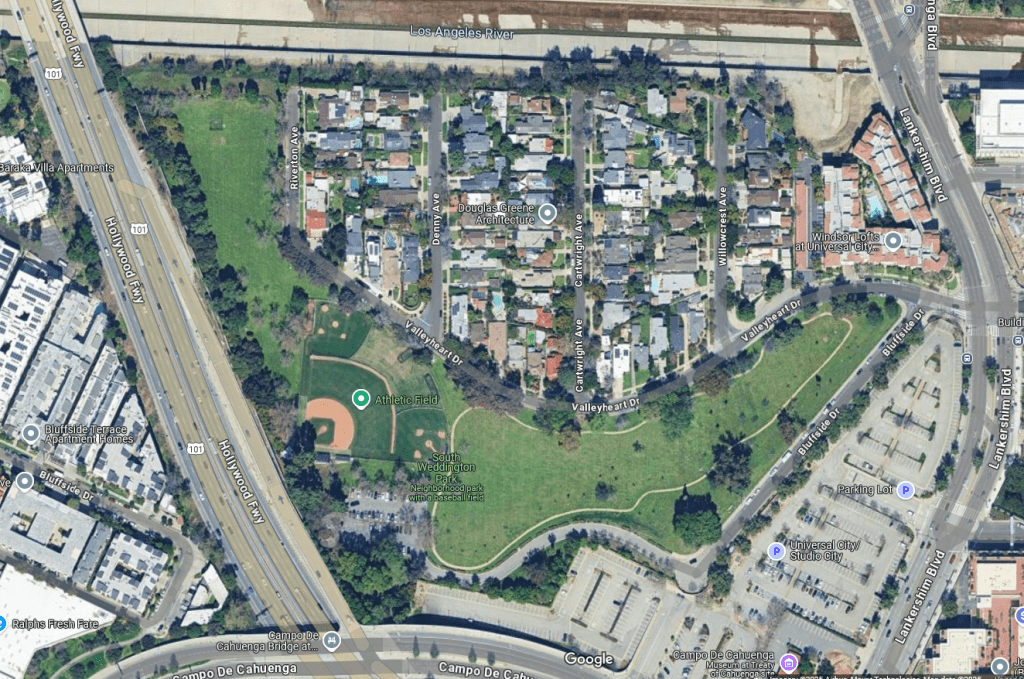
Between 1979 and 1984, Bluffside Park was the unofficial local name for South Weddington Park in Studio City, and it was the “secret” place where all of the hip cool young people from Studio City, North Hollywood, and the Hollywood Hills would meet up to find out the answers to the many important questions of the day:

  • Was there any good weed to score?
  • Does anyone know where to score some cocaine?
  • Where were the weekend house parties?
  • Were there any good bands playing at the Starwood, Gazzarri’s, or Phases?
  • Does anybody have any clove cigarettes?

Good weed was relatively easy to obtain around Los Angeles most of the time and some strains were vastly better than others—some of which would knock you on your ass—but getting your hands on some decent cocaine required knowing a guy who knew a dealer and trusting that the blow wasn’t cut with too much lactose or mannitol. Ultimately, you just had to trust the system and weren’t going to get ripped off.

The curious thing about cocaine is that while it impresses people as a classy drug used by sophisticated individuals such as artists, musicians, poets, actors, and writers—ergo, sophistication by association—it simultaneously drains your bank account at $100 per gram. That was a lot of money back then, especially for a low roller like me making only $5 per hour as an electricians apprentice. Indeed, a spare Benjamin was hard to come by but all too easy to spend foolishly in an attempt to impress friends and love interests. Although I did enjoy getting high on cocaine, I could only indulge in it occasionally because I needed to make rent on a regular basis, which was unlike some of the young adults in the neighborhood who were still living with their wealthy parents and always seemed to have a vial or two of cocaine in their pocket.

As it was, Bluffside was one of those local impromptu gathering places where sometimes only a handful of people would show up and at other times the small dirt parking lot was completely full of cars and anticipation. There was always a good chance that you would run into someone that you hadn’t seen in a while which would give you the opportunity to catch up on things, exchange phone numbers, and maybe get high together.

Unfortunately, the locals living in the Bluffside enclave hated the sometimes-noisy crowds that occasionally blasted the KROQ soundtrack of the day on the Blaupunkt radio installed in their parents BMW’s or Mercedes-Benz’s. Apparently, music by The Clash, The Dead Kennedys, The Police, the B-52’s, and Iggy Pop violated the collective sensibilities of the well-heeled neighborhood and so they would call the L.A.P.D. regularly.

The cops arrival would disburse the crowd remarkably fast when they rolled up because they were easily spotted due to the park being accessible only by two streets: Bluffside Drive to the east and Valleyheart Drive to the north. The park boundary was wedged between CA 101 to the west and the concrete L.A. River (a.k.a. “the wash”) to the north, and it was easy to ditch the cops along the verge of the 101 or the verge between the wash and the residential houses in the tony little neighborhood.

The unofficial yet generally accepted schedule at Bluffside was to meet on Friday night after work, disseminate and absorb all of the critical information, chose your adventure, and then meet again on Saturday night and repeat the process. By Sunday night, the talk was mostly about the disasters, misadventures, and the highlights of the previous 48-hours. There were also plenty of casual conversations revolving around music and food and books and movies and sometimes a bit of juicy gossip would creep into the conversation about who started dating, who broke up, and who was having sex with whom.

The legendary house parties were absolutely wild. There were many wealthy families living in the area who worked in the automotive, aerospace, music, television, or film industries, and some of them lived in these fabulous hillside houses that had large swimming pools some of which included detached cabanas or pool houses. Often, the parents would go on a lengthy vacation and leave their eighteen-year-old or so offspring at home by themselves because there is nothing more tedious and troublesome than traveling with adult children, the term of which appears to be an oxymoron.

Leaving an unsupervised eighteen-year-old “adult” at home was analogous to leaving an arsonist with a five-gallon jerrycan of gasoline and a match: At some point combustion was going to happen. One phone call to one friend would start a chain-reaction of other phone calls to other friends, and exponentially, the news got around quickly. Soon, hundreds of random people—some known, others being perfect strangers (if there is such a thing)— start showing up on a Saturday night to party their asses off like there was no tomorrow because, frankly, at that age most of us were living in the moment which was all that truly mattered.

The age span between eighteen and twenty-one is like purgatory because you are considered an adult and are of legal age to vote and engage in contracts or join the military or buy a car or borrow money from the bank to buy a house, but you can’t buy alcohol, one of the great privileges and pleasures of true adulthood. When you are stuck in this underage limbo, the only way to get alcohol was to know somebody who was old enough to buy it for you, or you had to resort to “pigeon” for it. To pigeon was to hang out in a liquor store parking lot out of sight of the store clerk and ask someone who was going inside the liquor store to purchase your alcohol for you. At best, the odds were 50/50. Circus Liquor in North Hollywood was my liquor store parking lot of preference because it was close to where I lived. Indeed, the only way to get your fifth of Cuervo Gold or a six-pack of Bud tall boys was by proxy. There were other, more nefarious ways like shoplifting, but I always considered theft one of the lowest forms of human conduct and refrained from engaging in such a lowly act.

This was a pre-GPS era, so unless you had a Thomas Guide in your car and knew the street address of the house party (of at least the general vicinity), you would often pile into the car of a guy who said that he knew where the party was, and along with your plain brown paper bag of beer or tequila, you drove off to parts unknown. We would often get lost and missed out on many house parties with this method. The surest way to find the house party was to convoy with a bunch of other cars that were following the guy in front who did have a Thomas Guide and snake your way up into the narrow streets of the Hollywood Hills.

One of these house parties was near Laurel Canyon Blvd and Mulholland Drive, overlooking Hollywood. The house was stylishly furnished, replete with leather couches, crystal chandeliers, marble, and all manner of artwork. There was a better than average live rock band playing under a cabana on the pool deck. There were several kegs of beer on ice in plastic trash cans that were lined up along the back wall of the house. Drinking Heineken from a keg is not the same as drinking Heineken from a bottle—it was considerably better, and so it flowed endlessly into my bottomless red cup. The house was jam-packed with partygoers and marijuana and clove cigarette smoke permeated the air. People were smashing out their cigarette butts on the hardwood floors and spilling their beers all over the house. Some people were snorting cocaine from the marble countertops in the kitchen.

As I was bumping my way through the crowd toward the band, Tom Armstrong, an old hooligan friend that I hadn’t seen in a while, spotted me from the opposite side of the pool and yelled out my name. We acknowledged each other. He was there with his friend Duke. Tom said something in Duke’s ear, and then they started walking briskly in opposite directions around the pool toward me. This could only mean one thing: They had conspired to throw me into the pool. Not tonight, boys! I spotted some Italian cypress trees at the far edge of the pool deck and decided that I was going to hide behind them. The thick crowd of people slowed them down considerably and I bent down as low as I could while winding my way through the thicket of people toward the trees hoping that Tom and Duke would lose sight of me.

When I got to the edge of the slate pool deck, I briefly glanced back to see Tom and Duke closing in on me. I took a step beyond the deck thinking that it was a planter bed where the Italian cypress trees were located, but it wasn’t…it was the ledge of a concrete retaining wall. I stepped off the ledge and fell down about twelve feet into the darkness and almost landed on a couple who were making out on a bench in the planter below. I hit the dirt hard on my right side. It knocked the wind out of me, and I was sure that I broke my right arm and maybe some ribs. The guy on the bench jumped up and said, “Dude—are you okay?” I couldn’t talk yet because I was still struggling to catch my breath, so I just nodded my head, slowly stood up, and limped away holding my arm and headed back toward my car to drive myself to the emergency room. On the way to my car which was parked way up the road, I ran into my friend Mark Flaata who had just arrived. By then I had recovered considerably in the miraculous way that one recovers quickly when one is young. My arm and ribs were definitely not broken, but my confidence definitely took a major hit. We went back into the party and stayed until the cops showed up around midnight and shut it down.

Meeting back at Bluffside the next night, we heard many other stories about the same wild party. It’s funny how people can be at the same place at the same time yet not run into each other while also having a completely different experience. Drama, comedy, run-ins with law enforcement, breakups, hookups, philosophical conversations, religious conversations, swearing off drinking alcohol or doing drugs, passing out on the front lawn, and musings about the meaning of life were all part of the various storylines that were told. In those moments, we represented our fleeting wasted youth in the truest form possible.

This was all part of an earnest—although ultimately futile—effort to stave off the requirement to get serious about life because no young person wanted to end up like their parents working long hours in jobs that they hated and being stuck with all of those serious adult responsibilities like insurance and mortgages and car payments and the multitudes of problems that seem to accompany them.

No matter our purest intentions, time marches forward mercilessly regardless of how tenaciously we try to hold it back, and most of the once fierce, invincible, carefree teenagers eventually become another cog in a massive, indifferent, mindless system that strips them of their soul and spits out their bones when it is done with them, repeating the infinite cycle of modern society.

Luckily, some of them survive with their souls intact. These are my kind of people.

Instagram: @m.snarky

Blog: https://msnarky.com

©2025. All rights reserved.